
In This Article
Why 1688 is Cheaper
The price gap between 1688 and Alibaba stems primarily from their distinct target markets, localization costs, and standard trade terms. 1688.com operates as a domestic wholesale marketplace within China, whereas Alibaba.com serves as a global cross-border trade platform.
Comparison Breakdown
| Cost Factor | 1688.com | Alibaba.com |
|---|---|---|
Primary Market | Mainland China (Domestic Buyers) | International Markets (Global Buyers) |
Standard Trade Terms | Domestic delivered price / EXW | FOB / CIF / DDP |
Supplier Type | Mix of domestic factories and local distributors | Mix of export-oriented factories and trading companies |
Regulatory Compliance | Chinese national standards (GB) | International certifications (CE, RoHS, FDA, etc.) |
Operational Overhead | Domestic sales teams & standard packaging | Multilingual staff, export compliance & overseas marketing |
3 Main Reasons for the Price Difference
Logistics and Trade Terms: 1688 suppliers quote based on domestic logistics or local factory-gate costs. Buyers must handle or pay separately for consolidation and international shipping. Alibaba suppliers typically quote FOB or DDP prices, which already bundle China inland freight, export customs clearance, port documentation, and sometimes international freight into the unit price.
Localization and Export Compliance Costs: Operating on Alibaba requires suppliers to maintain cross-border capabilities. This includes employing English-speaking sales staff, upgrading products to meet destination country standards (such as CE or FDA), and utilizing heavier, export-grade protective packaging. 1688 suppliers target the domestic market and bypass these specific cross-border compliance and language support expenses.
Platform Costs and Marketing ROI: While both platforms charge membership and traffic fees, the overall cost of customer acquisition on Alibaba.com (including premium memberships and international keyword bidding) is generally higher. Suppliers on both platforms factor their operational and platform marketing costs into their pricing models, resulting in higher base quotes on the international platform.
Calculate Total Landed Cost
A lower wholesale price quote on a web page does not guarantee a higher profit margin. To find the commercially viable sourcing channel, importers must compute the Total Landed Cost—the absolute sum of all expenditures required to move goods from the production line directly into your regional fulfillment center.
The Core Mathematical Formula
Total Landed Cost = Product Cost (EXW/FOB)+ Inland Logistics + Service Fees + Cross- Border Freight + Customs & Taxes + Transaction Leakage
Financial Simulation
Product: 500 units of custom wireless earbuds (HS Code: 8517.62).
Physical Logistics: Total volume approx. 0.45 CBM; Volumetric weight approx. 90 kg.
Destination Market Scenario: USA/EU destination via an Air Express or Fast-Sea LCL line.
Tax Assumption: Based on a 10% comprehensive rate covering customs entry fees, bond charges, and localized import taxes/fees.
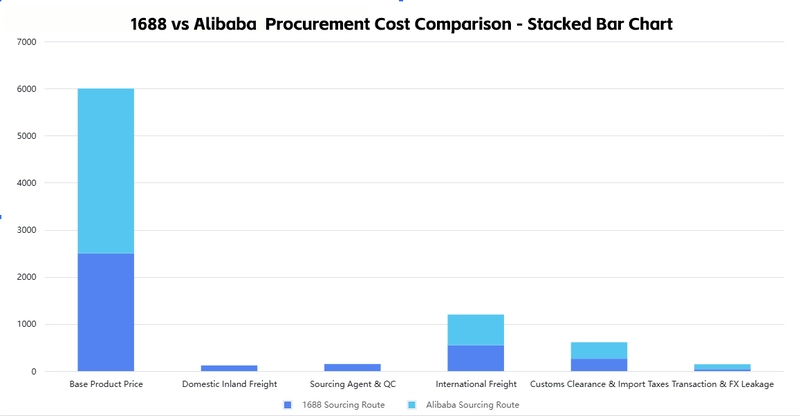
| Cost Component | 1688 Sourcing Route (Unbundled / Fragmented) | Alibaba Sourcing Route (Bundled / Standard Export) |
|---|---|---|
1. Base Product Price | $2,500 ($5.00 / unit) | $3,500 ($7.00 / unit) |
2. Domestic Inland Freight | +$120 | $0 (Included) |
3. Sourcing Agent & QC | +$150 (Flat fee or 5-6% commission) | $0 (Direct Management) |
4. International Freight | +$550 (Independent Forwarder LCL/Air) | +$650 (Alibaba Logistics / Supplier Agent) |
5. Customs Clearance & Import Taxes | +$262 (Based on $2,500 in merchandise value + $120 in shipping costs) | +$350 (Based on $3,500 FOB value) |
6. Transaction & FX Leakage | +$40 (FinTech Payment Channel) | +$105 (Platform Escrow Fee) |
Total Landed Cost | $3,622 ($7.24 per unit) | $4,605 ($9.21 per unit) |
Strategic Decision Framework
Source via 1688 if: Your order value is large enough to absorb fixed agent and domestic consolidation minimums (generally orders above $3,000), you have a trusted on-the-ground QC partner, and the product does not require complex destination-market medical or legal compliance certs.
Source via Alibaba if: You are executing trial orders, require immediate transactional escrow protection (Trade Assurance), need direct communication with an export-licensed entity, and want a streamlined, single-invoice procurement workflow.
How to Get Quality Products Cheaply
Sourcing on 1688 yields a genuine pricing advantage only if the products meet local quality standards and pass customs. Because 1688 lacks built-in international buyer protections and native English dispute resolution, mitigating quality risks requires data-driven filters, logistical consolidation, and category-specific parameters.
Vetting 1688 Suppliers in 5 Minutes
To avoid communication fatigue, filter potential suppliers by evaluating three verified performance indicators on their 1688 profile pages:
90-Day Repeat Purchase Rate (回头率): This is a highly accurate proxy for product stability. Aim for a rate above 20%. Experienced domestic trading companies and local e-commerce aggregators continuously reorder only from reliable manufacturers. A high repeat rate indicates consistent quality control.
Transaction Medal (交易勋章): Represented by a series of "A" icons (from 1A to 5A) in the shop header. Prioritize suppliers with a 3A to 5A rating. This indicates substantial monthly transaction volumes, ensuring the entity is an active market participant with established output capacity, rather than a dormant placeholder store.
Factory Verification & Audit Reports (实力商家/深度验厂): Do not rely solely on the "Business Scope" (经营范围) of the business license, as trading companies frequently include "manufacturing" terms. Instead, check if the supplier carries the "实力商家" (Source Power Merchant) badge or possesses a "深度验厂" (Deep Factory Audit) report. These profiles contain downloadable on-site inspection videos and verification documents compiled by independent third-party auditing firms (such as SGS or TÜV Rheinland).
Economical Sampling Tactics
Bulk purchasing without preliminary physical inspections poses a high capital risk. Optimize sample acquisition via these two industry-standard methods:
Domestic Sample Consolidation (集运拼样): Avoid paying separate international express charges (via DHL, FedEx, or UPS) to individual factories for isolated samples. Direct 5 to 10 different factories to ship their samples domestically to your designated freight forwarder's Chinese warehouse. Instruct the forwarder to unbox the items, discard non-essential domestic cardboard, and consolidate all samples into a single international shipment. This routinely reduces international carriage outlays by 50% to 70%.
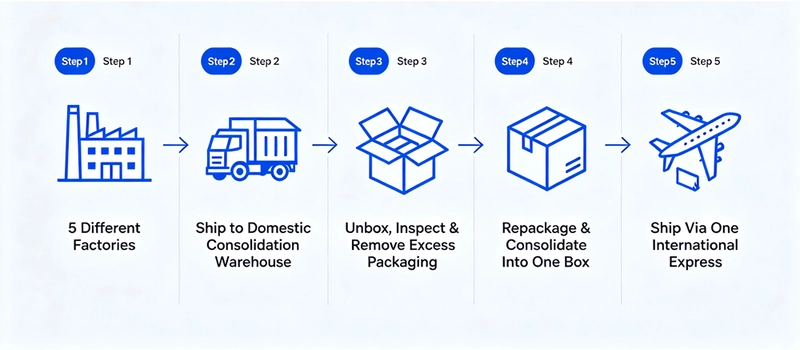
International Logistics Consolidation Process Amortized Sample Rebates (样品费大货抵扣): 1688 suppliers typically charge a premium (often 2x to 3x the wholesale unit price) for individual sample units to deter retail consumers. Serious manufacturers will agree to credit this surcharge back to you once you place a formal production run that meets their minimum order quantity (MOQ).
Use this concise, standard script via the Wangwang app to secure this arrangement:
“你好,我们正在筛选长期合作的源头工厂。如果样品测试符合要求,请问后期大货订单达到 MOQ 时,样品费差价可以全额返还或者抵扣大货货款吗?”
(Hello, we are vetting long-term manufacturers. If the sample meets our criteria, can the sample price difference be fully refunded or credited against the bulk order invoice upon meeting the MOQ?)
Product Category Framework: 1688 vs. Alibaba
1688 does not maintain a price advantage across all product segments when post-processing and compliance verification costs are factored into the total budget.
Where 1688 Offers Peak Cost Efficiency: Low-complexity, non-regulated consumer goods with low mechanical defect rates. This includes apparel, textiles, home organization products, injection-molded plastics, and basic hardware. These categories face minimal international regulatory barriers, and 1688 prices are frequently 20% to 40% lower than export-oriented platforms.
Where Alibaba Offers a More Viable Route: Complex consumer electronics, medical-grade wellness equipment, and products destined for heavily regulated demographics (e.g., children's toys). Products such as power banks, beauty devices, or toys require comprehensive compliance certificates (CE, FCC, RoHS, FDA) for legal importation and insurance coverage. 1688 factories rarely possess these international certificates or the underlying Technical Files (such as circuit schematics or component UL data) required to apply for them. Alibaba suppliers catering to export markets generally maintain these compliance pathways, factoring the regulatory costs into their quotes and saving you from costly customs seizures or compliance deadlocks.
Advanced Hacks for Cheaper Sourcing
Getting the absolute lowest price requires timing, the right communication strategy, and leverage. Sourcing from China is a game of shifting variables. If you know how to play them, you can drop your unit costs by another 10% to 15%.
Sourcing Timing: Capacity Optimization Windows
Production pricing and factory lead times fluctuate based on localized industrial cycles. Importers must map their ordering schedules around three hard calendar constraints:
The Chinese New Year (CNY) Bottleneck (January–February): Factories run at maximum capacity to clear backlogs before a mandatory 2-to-3-week nationwide closure. During this pre-holiday rush, labor shortages occur, material costs fluctuate, and quality control defect rates rise. Importers should book baseline production runs no later than November, or defer placement until late March when workforce stability returns and factories seek new volumes to balance their lines.
The Dual-Track Exhibition Seasons (April & October): Alibaba.com suppliers prioritize international delegations during the Canton Fair (Guangzhou) and similar global trade shows. During these windows, export sales teams focus on high-volume contractual accounts and rarely discount small-to-mid-tier trial orders. Conversely, 1688.com domestic suppliers remain largely unaffected by these export exhibitions, as their primary operations cater to the domestic market.
The Summer Slack Period (June–August): This represents the standard consumer retail off-season. Factories frequently face idle manufacturing lines and surplus capacity. This period offers buyers the highest negotiation leverage to secure lowered Minimum Order Quantities (MOQs) and optimized wholesale pricing.
Platform-Specific Negotiation Scripts
Effective communication requires aligning with the distinct business models of each marketplace.
For Alibaba.com Suppliers: Projecting Scalable Contractual Value
Export manufacturers cushion initial Free on Board (FOB) quotes to allow for standard negotiation. Importers should frame negotiations around predictable, recurring supply requirements rather than demanding isolated discounts.
The Pitch: "We are finalizing our initial trial allocation of [X] units. However, the current FOB quote restricts our projected retail launch margins in this market. If you can establish a baseline price of [$X] for this introductory run, we can map out our production pipeline with your facility across the upcoming three quarters."
For 1688.com Suppliers: Prioritizing Transaction Speed and Liquidity
1688 merchants operate on high-volume, low-margin internal trade frameworks. They reject extended communication cycles and complex modifications. Negotiations must emphasize standard specifications, immediate transactional closing, and direct payment.
The Authentic Wangwang Script: “你好,我司采购大货不需要做任何定制改动,现货直接发。如果底价合适,我们今天可以直接在线上拍下全款付清(走 1688 平台交易)。后续我们需要长期稳定拿货,请问能给到多少底价?”
(Hello, our company requires no custom modifications for this bulk order; we take standard stock. If the bottom price is correct, we can create the online transaction order and pay the full balance via the platform today. This will be a recurring supply chain; what is your absolute bottom trade rate?)
Advanced Agent Management: Lowering Your Unit Overhead
Many buyers try to avoid sourcing agents to save 5%. This is a math mistake. A professional on-the-ground agent in China routinely saves you more than their commission by consolidating your supply chain.
Price Benchmarking: Agents speak the local dialect, understand regional material costs, and can call 3 to 4 offline factories that are not even listed on 1688 to run a price bidding war for your order.
Quality Gates: Discovering defects at your local warehouse means total loss. An agent catches mistakes at the factory door, forcing the supplier to rework the batch on their dime before the goods ever leave China.
Consolidation Math: If you buy from three different 1688 factories, you face three separate domestic shipping bills and three customs clearance files. An agent pulls all three orders into one warehouse, repacks them into high-density boxes to strip out volumetric weight, and exports them under a single shipping bill. Your logistics savings alone usually cover the agent's fee.
Comments