In This Article
- Red Flag #1: Their Product Catalog Has No Focus
- Red Flag #2: They Can't Discuss Technical Details
- Red Flag #3: The Business License Says Something Different
- Red Flag #4: Their Alibaba "Verified" Badge Is Misleading
- Red Flag #5: They Refuse Factory Visits or Audits
- Red Flag #6: The Bank Account Doesn't Match the Company
- Red Flag #7: Their Pricing Is Suspiciously Low
- Real Factory vs Trading Company: Cheat Sheet
- So What If Your Supplier IS a Trading Company?
- The Verification Checklist We Actually Use
You found a supplier on Alibaba. Their profile looks great. They claim to be a "direct manufacturer." The prices seem reasonable. You place an order, and then the nightmares begin: mysterious delays, inconsistent quality, zero transparency, and a sinking feeling that someone, somewhere, is pocketing a markup you never agreed to.
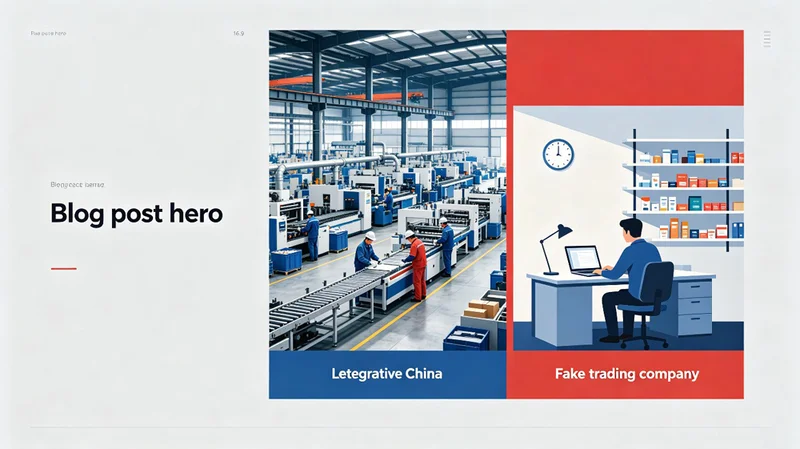
Here's the uncomfortable truth. A huge chunk of the suppliers presenting themselves as factories on B2B platforms are actually trading companies or middlemen running their operation out of a small office. And once you realize it, you've already lost leverage.
We've been sourcing from China for over eight years, and we've seen this play out dozens of times. Below are the seven red flags we check for every single time we evaluate a new supplier. These are the signals that separate a real factory from someone pretending to be one.
Red Flag #1: Their Product Catalog Has No Focus
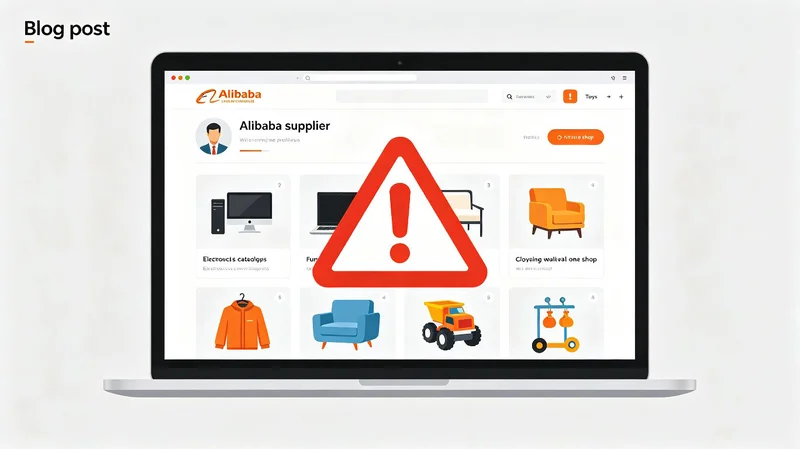
Real factories specialize. That's just how manufacturing works. A factory that makes stainless steel water bottles doesn't also produce Bluetooth speakers, yoga mats, and LED strip lights. The machinery, the raw materials, the workforce skills, the quality control standards, all of that is completely different.
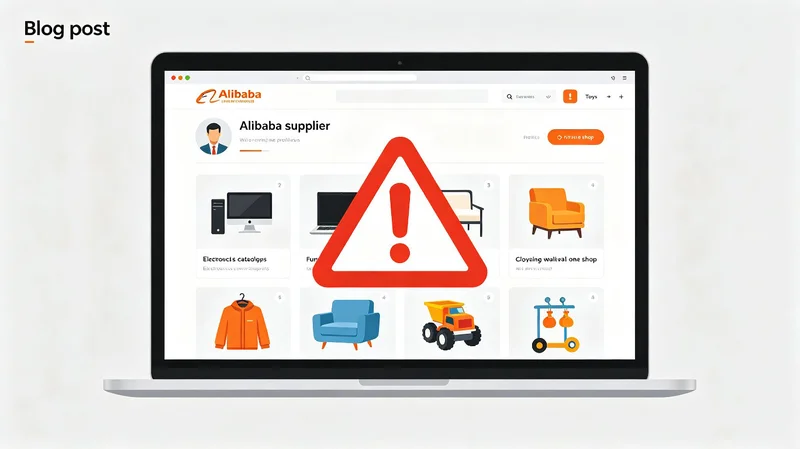
So when you scroll through a supplier's Alibaba storefront and see fifteen unrelated product categories, that's not "diversification." That's a trading company sourcing from multiple factories and slapping their branding on everything.
Does this mean every supplier with multiple categories is automatically a trading company? Not necessarily. Some large manufacturing groups have subsidiaries producing different product lines. But for small to mid-sized suppliers, an unfocused catalog is one of the earliest and most reliable warning signs.
Quick Test: Check Their Top 3 Categories
Look at the first three product categories listed on their profile. If those categories require fundamentally different manufacturing processes (e.g., injection molding vs. textile sewing vs. PCB assembly), you're almost certainly not talking to a factory.
Red Flag #2: They Can't Discuss Technical Details
This one usually shows up in the first or second email exchange. Ask a real factory engineer about injection molding parameters, tolerance specs, or material grades, and you'll get a precise, technical answer. Ask a trading company sales rep the same question, and you'll get silence, vague replies, or "let me check with our engineers and get back to you."
Nothing wrong with someone needing to double-check details. But if it happens on every technical question, that person is a sales intermediary, not someone who walks the production floor every day.
| Question to Ask | Real Factory Response | Trading Company Response |
|---|---|---|
| What material grade do you use for this component? | SUS304 stainless steel, 0.8mm wall thickness | "High-quality stainless steel, very durable" |
| What's your standard lead time for 5,000 units? | 25-30 days after deposit, 18 days for repeat orders | "Around 30 days, maybe faster if you order more" |
| Can you send me your QC inspection report template? | Sends a detailed AQL-based checklist within hours | "We can arrange that during production" (never sends it) |
| What's your monthly capacity for this item? | 80,000 units per month, currently at 65% utilization | "Very large capacity, no problem for any quantity" |
The Video Call Test
Here's something that catches a lot of people off guard. Ask your contact to do a video call from the factory floor. Not their office, not a meeting room, but the actual production area where your product would be made. A real factory will do this without hesitation. A trading company will deflect, citing "confidentiality" or "the factory is in a different city."
We started doing this routinely in 2023, and honestly, it's saved us more time than any other single check. If they won't show you the production floor on a quick WeChat video call, that tells you everything you need to know.
Red Flag #3: The Business License Says Something Different
This is the one red flag that almost no beginner importer knows about, and it's arguably the most definitive proof of all.
Every registered company in China has a business license (营业执照) that includes a field called "business scope" (经营范围). This field legally defines what the company is authorized to do. If a supplier claims to be a manufacturer but their business scope says "sales," "trading," "import/export agency," or "wholesale of [product category]," they are not a factory. Period.
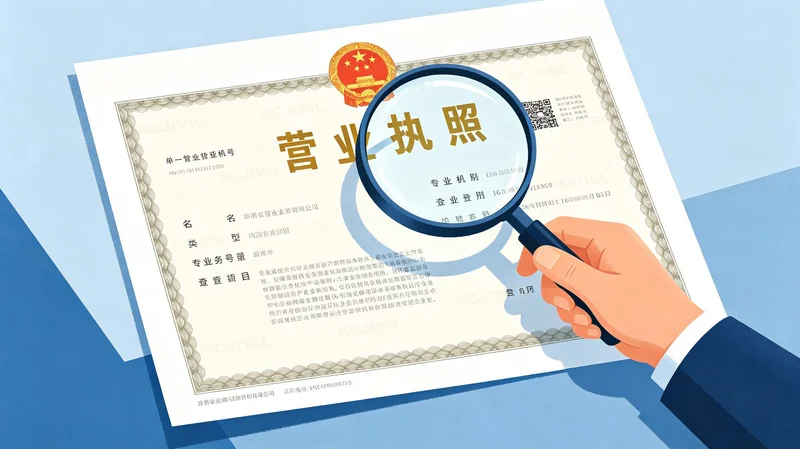
Now, how do you actually get your hands on this document? A few ways:
Ask the supplier directly to send you a copy of their business license. A legitimate factory will do this without pushback.
Use the National Enterprise Credit Information Publicity System (国家企业信用信息公示系统) to search by company name. It's the official government database.
Use third-party services like FlatFee Sourcing (around $99-199 per report) if you want someone else to handle the verification.
What Else to Check on the License
Beyond the business scope, look at these fields too:
Registered capital (注册资本): Legitimate factories typically have 1 million RMB or more. Anything under 500,000 RMB is a strong warning sign.
Establishment date (成立日期): If they claim "10 years of experience" but were registered in 2021, something doesn't add up.
Registered address (注册地址): Cross-reference this with the address they give you for the factory. If the registered address is in a commercial office building, not an industrial zone, that's a problem.
Company type (公司类型): Look for "limited liability company" (有限责任公司). If it says "individual business" (个体工商户), that's a sole proprietorship, not a factory.
Red Flag #4: Their Alibaba "Verified" Badge Is Misleading
Let's talk about the elephant in the sourcing room. Alibaba's "Gold Supplier," "Verified Supplier," and "Trade Assurance" badges sound impressive, right? They're designed to sound impressive. But here's what they actually mean.
Gold Supplier status means the company pays Alibaba an annual fee for premium listing placement. That's it. It does not mean Alibaba has inspected the factory, verified their production capabilities, or endorsed their product quality. It's a paid advertising tier.
Verified Supplier is a step up in that Alibaba does commission a third-party inspection body (usually SGS, Intertek, or TUV) to visit the supplier. But these visits are typically one to two hours long. The inspector verifies basic commercial information: does the company exist at this address? Do they have a business license? That kind of thing.
They do not conduct a full manufacturing audit. They don't verify production capacity, quality management systems, or subcontracting arrangements. Think of it as a "this company physically exists" check, not a "this company is a legitimate factory" check.
Trade Assurance Doesn't Mean What You Think
Trade Assurance is Alibaba's escrow-style payment protection program. It's better than nothing, sure. But Dan Harris from China Law Blog once called it "borderline worthless," and while that's harsh, the sentiment isn't wrong. Trade Assurance covers basic non-delivery or quality-not-matching claims, but filing a dispute is slow, Alibaba mediates (not arbitrates), and the payout caps are often much lower than your actual order value.
Use these badges as one data point, not as proof of legitimacy.
Red Flag #5: They Refuse Factory Visits or Audits
This one should be obvious, but you'd be surprised how many importers skip it.
A real factory wants you to visit. Factory tours are how they build trust, showcase their capabilities, and close deals. If your supplier dodges your visit request with excuses like "our production area is confidential" or "we're too busy right now, maybe next quarter," that's not a scheduling conflict. That's a cover-up.
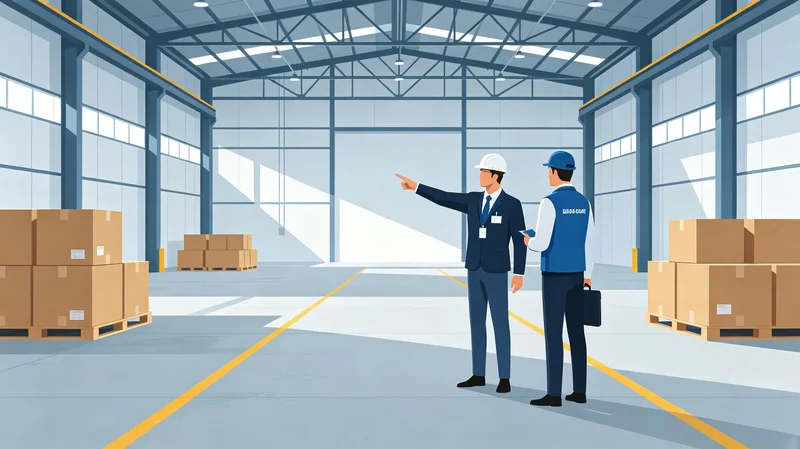
But here's the thing that trips up a lot of buyers. Some trading companies will actually let you "visit" their facility. You show up at an address in an industrial zone, someone gives you a tour of a clean showroom, you see some workers packing boxes, and you walk away thinking you've seen the factory. What you actually saw was the trading company's packaging warehouse or a shared showroom space.
We've learned to push harder during visits. Specifically:
Ask to see the raw material storage area. Real factories have warehouses full of raw materials (steel coils, fabric bolts, plastic pellets). Trading companies don't.
Ask to walk the production line. Look for machines actually running, workers performing specific operations, work-in-progress on the assembly line.
Ask to see the quality control lab or testing area. Even basic factories have some testing equipment (calipers, spectrometers, drop-test rigs).
Ask to meet the factory manager or production lead, not just the salesperson. If the sales rep is the only person available to show you around, that's a clue.
Red Flag #6: The Bank Account Doesn't Match the Company
Here's a red flag that most articles about supplier verification completely miss, which is wild because it's so simple to check.
When you're ready to place an order, the supplier will send you a pro forma invoice (PI) with bank details for the wire transfer. Look at the beneficiary name on that invoice. It should match the supplier's registered company name exactly. If the beneficiary name is different from the company you've been talking to, or worse, if it's a personal name, you're dealing with a middleman.
Trading companies routinely route payments through their own accounts, through Hong Kong shell companies, or even through personal bank accounts. Sometimes they'll tell you "this is our finance company" or "for tax purposes we use a different account." Don't buy it. A legitimate factory will receive payment in its own company name.
And while we're on the subject of bank accounts, here's another detail. If the bank is in Hong Kong and the factory is supposedly in mainland China, that's worth questioning. Many trading companies set up HK entities to make international payments easier, but real factories typically receive payments through mainland Chinese bank accounts in their own name.
The Courier Address Test
Want another quick verification hack? When ordering product samples, don't let the supplier arrange shipping. Use your own courier account (DHL, FedEx, UPS) and have the pickup address be the factory address they gave you. When the courier driver shows up at that address to pick up the samples, they'll confirm whether it's actually a factory or a small office in a commercial building. We've been doing this since 2022, and it's caught two suppliers who were lying about their facility location.
Red Flag #7: Their Pricing Is Suspiciously Low
Pricing tells you a lot if you know how to read it. Real factory pricing has structure. There are volume breaks, material grade options, packaging cost variations, and tooling amortization that shows up differently depending on order quantity. The quote from a genuine manufacturer often looks complex because real costs are complex.
Trading company pricing, on the other hand, tends to look like this: a clean, round number that includes everything. "$4.50 per unit, FOB Shenzhen, any quantity." No breakdown of material costs, labor costs, or packaging. That's not because the factory is being generous. It's because the trading company applied a flat markup to someone else's quote and doesn't actually know the underlying cost structure.
Another pricing signal: outlier pricing relative to the market. If a supplier quotes you 40% below the average of five other quotes you've received, that's not a good deal. That's either a bait-and-switch (they'll raise the price after you pay the deposit) or they're using inferior materials you haven't specified.
The Three-Quote Rule That Actually Works
Most people say "get three quotes" and leave it at that. Here's how we do it differently:
Get quotes from at least five suppliers, not three. More data points means you can see the real price range.
Toss out the highest and lowest quotes immediately. Focus on the middle three.
Compare the structure of the remaining quotes, not just the total price. Does each supplier break down costs the same way? Are there line items one supplier includes that others don't?
Ask the top two candidates to explain their pricing in detail. A real factory will walk you through material costs, labor allocation, and overhead. A trading company will give you a vague summary.
Real Factory vs Trading Company: Cheat Sheet
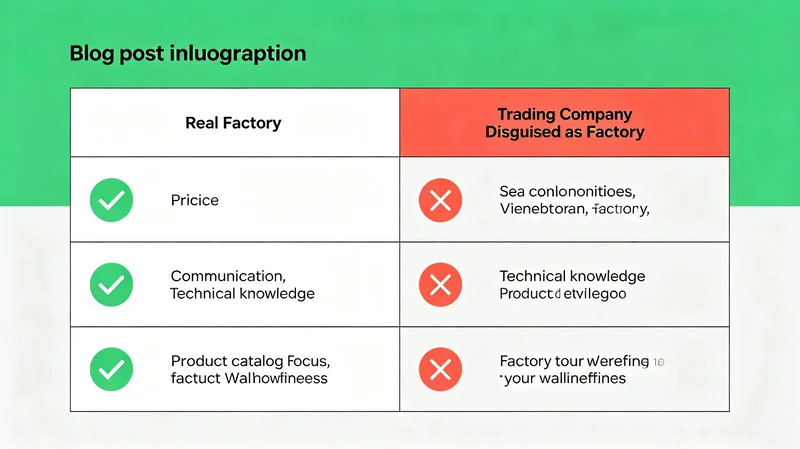
| What You're Checking | Real Factory | Trading Company in Disguise |
|---|---|---|
| Product catalog focus | 1-3 related categories | 8+ unrelated categories |
| Technical knowledge | Detailed, precise answers | Vague, defers to "engineering team" |
| Business license scope | "Manufacturing" or "Processing" | "Trading," "Sales," or "Wholesale" |
| Factory visit | Welcomes you, shows full production | Shows showroom only, limits access |
| Bank account on PI | Matches registered company name | Different company, HK entity, or personal name |
| Pricing structure | Detailed breakdown with cost components | Clean round number, no breakdown |
| Video call from floor | No hesitation, shows live production | Deflects, offers office meeting instead |
| Registered capital | Typically 1M+ RMB | Often under 500K RMB |
So What If Your Supplier IS a Trading Company?
Here's a nuance that most "how to spot fake factories" articles get wrong. Not all trading companies are evil. Some provide genuine value, especially for small businesses importing relatively low quantities.
A trading company can be useful when:
You're ordering small quantities that don't meet a factory's MOQ.
You're sourcing multiple products from different factories and want consolidated shipping.
You don't have the expertise or bandwidth to manage factory relationships directly.
You need someone who speaks fluent English and understands Western quality expectations.
The problem isn't trading companies themselves. The problem is trading companies that lie about being factories. There's a big difference between choosing to work with a middleman and being tricked into one.
If you do decide to work with a trading company, at least do it with your eyes open. Negotiate harder on price (you're paying their markup), ask which factory will actually produce your goods, and insist on a factory audit of that specific facility before placing any large orders. You can learn more about the cost of working with sourcing professionals in our guide on China sourcing agent costs in 2026.
The Verification Checklist We Actually Use
Before placing any order with a new supplier, we run through this checklist. It takes about 30 minutes if you know where to look, and it's caught problems for us more times than I can count.
Product catalog scan: Are they focused or all over the map?
Technical probe: Send three specific technical questions. How fast and how detailed is the response?
Business license pull: Check the business scope, registered capital, and address.
Platform badge reality check: What do those "verified" badges actually mean for this supplier?
Factory visit request: Ask to visit or do a video call from the production floor.
Bank account check: Compare the PI beneficiary name against the registered company name.
Pricing analysis: Get at least five quotes, compare structure not just total.
Courier test: Send your own courier for sample pickup at the factory address.
Background search: Google the company name plus "scam," "fraud," or "complaint."
Sample order first: Never go straight to a full production run. Test with a small sample order.
Look, nobody goes into China sourcing expecting to get scammed. But the suppliers who pretend to be something they're not are counting on exactly that: your optimism and your inexperience. The seven red flags above aren't foolproof, but they'll catch the vast majority of imposters before you've wired a single dollar.
Trust your gut, verify everything, and always, always start with a sample order.
Comments